
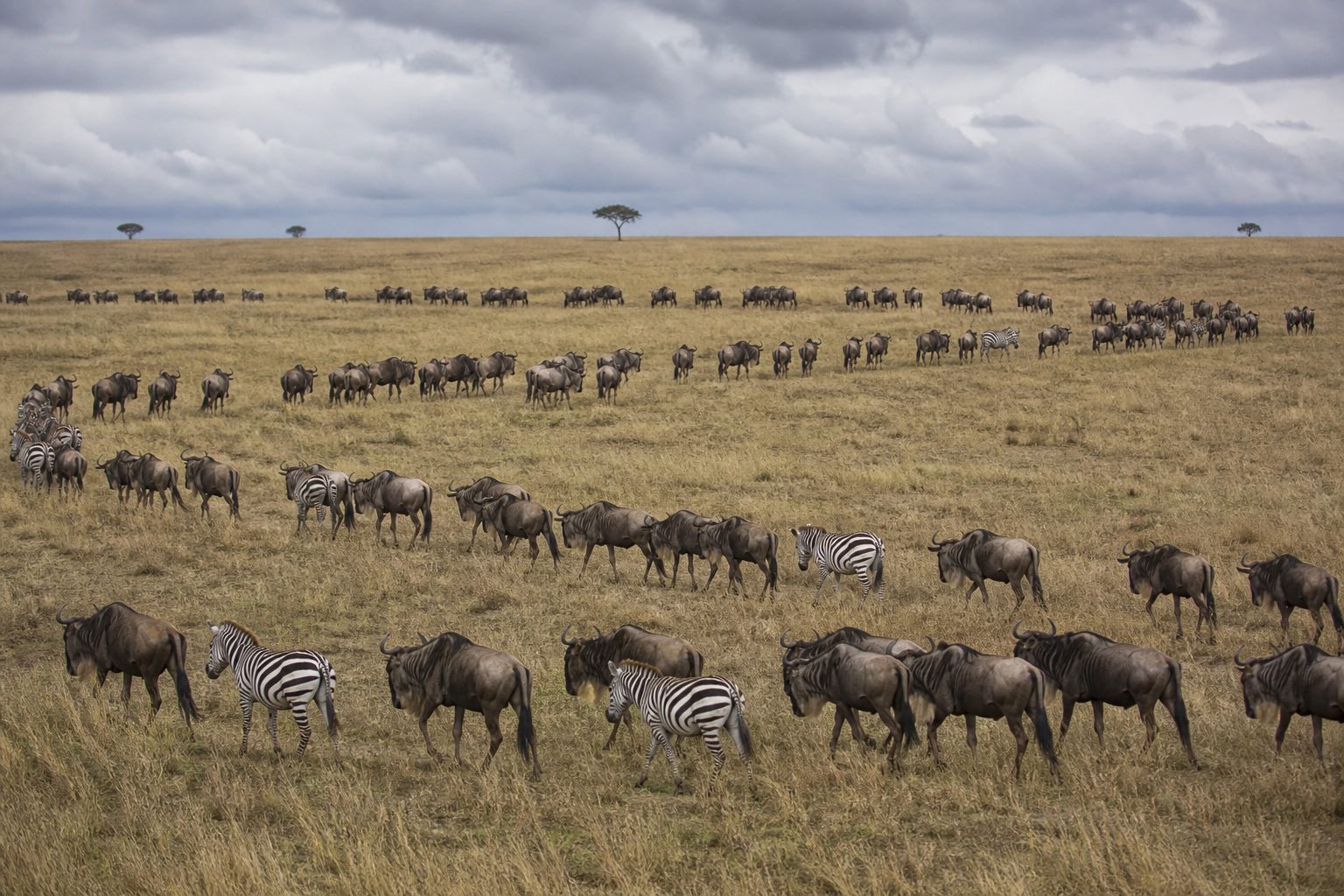
Migration reality
Can You Guarantee a River Crossing?
A thousand wildebeest bunch at the water's edge, snort and shuffle, retreat, bunch again — then one animal commits, and the whole herd follows in a churn of spray and noise that can last twenty minutes or two hours. No one, anywhere, can tell you the exact morning that will happen. Here is what brings the herds to the river.
The direct answer
No. Nobody can guarantee a river crossing on a specific day — herds cross when pressure builds behind them and conditions at the riverbank feel right to them, not on a schedule. A longer stay near the river gives the movement time to unfold, but the moment remains wild.
What decides when a crossing happens
A crossing starts with pressure, not planning. As grazing thins out on one side of the river and the herd keeps growing at the water's edge, animals at the front get pushed forward by the sheer weight of numbers behind them. Add a spooked reaction to a crocodile, a lion, or nothing in particular, and the front breaks — sometimes at dawn, sometimes at 2pm, sometimes not for three more days even with thousands of animals staged at the bank.
- Grazing pressure on the near bank builds until crossing becomes worth the risk to the herd.
- Predator presence at a given crossing point can delay a crossing for hours or push it to a different spot entirely.
- River conditions — water level, current, bank steepness — shift which crossing points herds actually use.
- Herd psychology means a crossing can start, stop, and restart repeatedly before it actually happens, or fizzle out completely for that day.
"A crossing starts with pressure, not planning."
What Actually Decides When a Crossing Happens
What gives you more time with the herds
Four things move the needle, and none of them involve promises:
- Season. July through October is when herds are reliably present near the river system — travel outside that window and there's simply nothing staged to cross.
- Position. Base yourself in the Mara Triangle or Mara North, where the river runs closest to where herds concentrate, rather than an area with no river frontage at all.
- Days. A single game drive gives you one roll of the dice. Three or four consecutive mornings near known staging points compounds your chances considerably.
- A guide who reads the herd. Experienced guides watch bunching behaviour and radio chatter to reposition toward a likely crossing rather than waiting at a fixed spot.
What to expect if it doesn't happen
Most multi-day trips in the right season and area see substantial migration activity — big herds grazing, moving, calling — even on visits without a dramatic crossing. That's not a consolation prize; it's most of what makes the migration remarkable in the first place. A crossing is the highlight reel moment, not the whole experience.
Frequently asked questions
What time of day do most crossings happen?
There's no fixed time — crossings have been observed at every hour of daylight. Morning and late afternoon game drives simply give you more hours of observation, not a higher inherent chance per hour.
How many days should I stay near the river?
Three to four consecutive days near the river allows more time to follow the herds than a single day or a fly-by visit. See our guide to staying near the migration.
Can I get a refund if I don't see a crossing?
No responsible operator offers a refund tied to a specific wildlife event, since none can control it. If a crossing is your absolute priority, tell our team directly so the itinerary allows several days near the river.
Are August and September better than July or October?
August and September are commonly cited as the months with the highest historical frequency of crossing activity, but both July and October have produced dramatic crossings too. See our August vs September comparison for the nuance.
Related reading
Ready to plan around the migration?
Tell us your travel window and whether crossings are your priority. We’ll allow the time and choose the areas that keep you close to the herds’ movement.